Surf Spots in Taghazout: The Complete Guide to the Best Waves in Morocco (2026)
The best surf spots in Taghazout to discover in 2026 — from Anchor Point to beginner beaches. Your complete guide to surfing in Morocco.
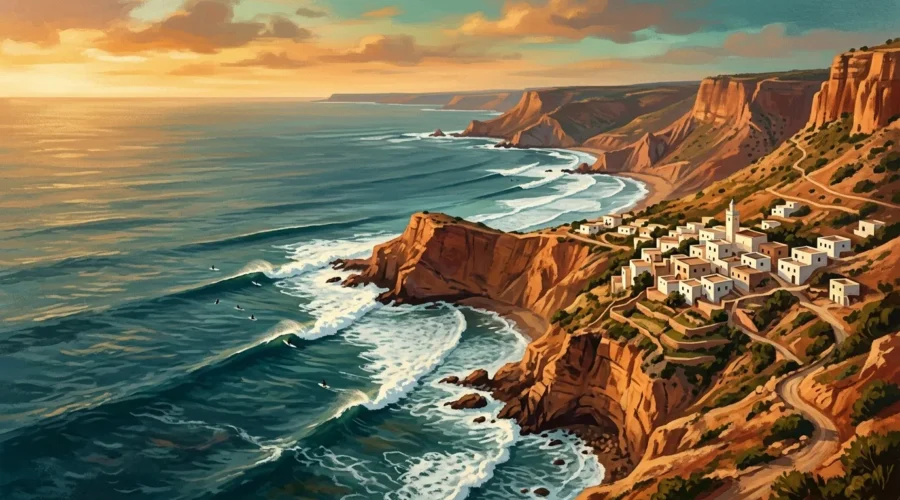
Il y a un moment — quelque part entre l’atterrissage à Agadir and the spectacle of the Atlantic light embracing the cliffs at the golden hour — when you realize you made an excellent life decision.
Taghazout does that to people.
This small fishing village clings to the Moroccan coast — about twenty kilometers north of l’aéropot d’Agadir — has quietly become one of the most sought-after surfing destinations on the planet. Not in the tourist-packed Bali kind of way. More in the "when you know, you know" kind of way. The waves are world-class. The tagines are extraordinary. The pace of life forces your nervous system to truly unwind, perhaps for the first time in months. And the surfing? Well, let's talk about that.
Whether you're a seasoned surfer who's been watching Anchor Point videos on YouTube for years, or a complete beginner who's never even been on a board in your life—Taghazout has a wave with your name on it. This guide covers every major break, the best time to come, what to pack, and everything else.
C’est parti.
Why Taghazout? The Short Version
Most surf destinations force you to choose between good waves and a good atmosphere. Taghazout, however, doesn't choose. It offers both with the natural laid-back vibe of a place that's been doing this for decades.
The coastline here is shaped by the North Atlantic swell machine—the same system that feeds the waves of southwest France and the Canary Islands—channeled into a series of rocky points and sandy bays that produce some of the longest and most consistent rights in the world. Add over 300 days of sunshine a year, surfable water temperatures year-round, and a cultural richness that no tropical resort can replicate, and you begin to understand why European surfers have been making this pilgrimage since the 1970s.
Et c’est encore mieux aujourd’hui.
When to Go: The 2026 Surf Season in Taghazout
Timing matters enormously here — perhaps more than anywhere else — because the seasons offer truly different experiences.
| Season | Month | Wave size | Water temperature | Ideal for |
|---|---|---|---|---|
| High season | October – April | 1,2m – 3,5m+ | 16°C – 18°C | Intermediate to expert surfers |
| Mid-season | May, September | 0,6m – 1,5m | 18°C – 20°C | All levels, fewer people |
| Summer | Juin – Août | 0,3m – 1m | 20°C – 22°C | Beginners, families |
High season (October to April) est le moment où l’Atlantique Nord se déchaîne vraiment. Les houles arrivent avec puissance et régularité, les fameux point breaks s’animent, et le peloton international de surfeurs débarque. C’est pendant cette période que Taghazout forge sa réputation.
L’été is a completely different story — smaller, gentler, warmer. If you're learning to surf, summer is frankly ideal. The pressure eases, the crowds disperse, and the sandy beach breaks become truly welcoming playgrounds.
My honest opinion: if you're an intermediate surfer, come between November and February. If you're still a beginner, late May or September offers the best compromise between decent conditions and manageable crowds.
Surf Spots: From Beginner to Expert Level
1. Panorama Beach — The Beginner's Best Friend
Level : Absolute beginner — intermediate Wave type: sandy beach break Best swell direction:NO–W
If you've never surfed before, Panorama is where your adventure begins. It's a gentle, forgiving sandy beach break located just south of the village, offering slow, rolling waves that give you time to stand up, find your balance, and understand why everyone is so obsessed with the sport.
Almost every surf school in Taghazout holds its beginner lessons here. The seabed is sandy—no rocks, no reef—which is a huge plus when you're falling off your board every thirty seconds (which will happen, and it's perfectly normal). The atmosphere is relaxed, the instructors are patient, and in good weather, you'll catch your first wave here and spend the rest of your trip chasing that feeling.
2. Banana Beach — Calm Waves, Maximum Atmosphere
Level : Beginner — Intermediate Wave type: sandy beach break Best swell direction: NO
Just north of Taghazout is Banana Beach, a crescent-shaped bay with turquoise waters that makes you question every life decision that has kept you in an office for the past three years.
The waves here are consistent and accessible without being boring. On smaller swell days, intermediate surfers can work on their turns and timing without the pressure of a point break lineup. It's also an absolutely gorgeous spot to sit on the beach and watch the more experienced surfers while you eat a banana (of course).
Practical tip: Banana Beach bénéficie d’une belle ombre en fin d’après-midi, ce qui en fait une option idéale pour éviter le soleil marocain de plein midi lors des sessions estivales.
3. Hash Point — Where Beginners Become Intermediate
Level : Intermédiaire Wave type: Right break point Best swell direction: NO–N
This is where things start to get really interesting. Hash Point—named after the legendary gathering place it overlooks—is a right-hand point break that offers your first real taste of what makes this coastline so exceptional. The waves roll steadily along the rocks, providing longer rides than beach breaks and an introduction to the rhythm of point break surfing.
It's manageable enough for a surfer who can hold their own on green waves, but rewarding enough that you'll be reliving your best rides over dinner. The rocky shoreline means water shoes are a wise choice for paddle-outs.
C’est aussi l’un des spots les plus conviviaux de la côte — le café au-dessus du break observe les surfeurs depuis ses chaises en plastique depuis des décennies, et l’atmosphère est décontractée et communautaire d’une façon qui semble résolument Taghazout.
4. Mysteries (Devil’s Rock) — The Progression Spot
Level : Intermediate — advanced Wave type: Right break point Best swell direction: NO
Mysteries sits somewhere between Hash Point and the serious stuff, and it honestly deserves its nickname, "Devil's Rock." The wave here is faster and hollower than Hash, with sections that demand real commitment. Hesitation is punished. Confidence is rewarded.
On a good NW swell, Mysteries produces some truly exciting waves—fast walls, the occasional barrel, and long rides when the swell lines up correctly. The rocky bottom demands vigilance and respect, but for an intermediate surfer looking to progress, this spot offers the right challenge at the right time.
5. Boilers — The Local Spot You Should Know About
Level : Advanced Wave type: Reef break right Best swell direction: N–NO
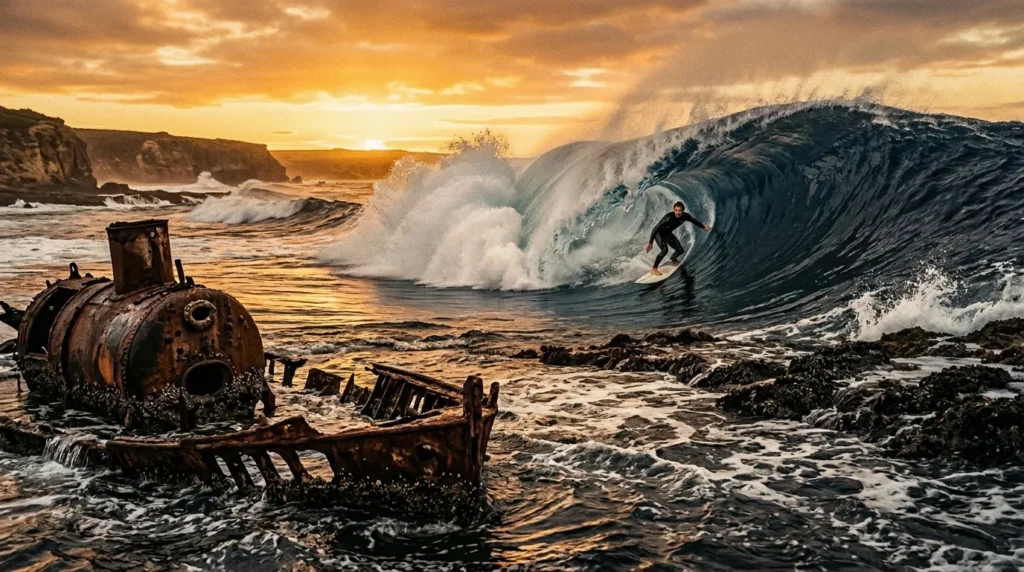
Baptisé d’après les restes rouillés d’une chaudière de naufrage visible à marée basse, Boilers est l’un des secrets les mieux gardés de la région. C’est un right-hander rapide et puissant qui déferle sur un récif peu profond, et il récompense les surfeurs capables de lire une vague rapidement et de s’engager dans des drops tardifs.
In good weather—good swell, favorable tide, clean conditions—Boilers is spectacular. Long, walling rides with plenty of challenging sections to work. It's located between Taghazout and Anchor Point, often overlooked by visitors focused on the flagship breaks, meaning the lineup can be surprisingly sparse compared to its more famous neighbors.
6. Killer Point (Killers) — Serious Waves for Serious Surfers
Level : Advanced — expert Wave type: Right break point Best swell direction: N–NO
Killer Point. Le nom n’est pas accidentel.
This break, located just north of the village of Taghazout, is one of the longest straight point breaks on the entire Moroccan coast—and in a big winter swell, it's downright intimidating. Waves here can reach twice a man's height or more, breaking for what feels like hundreds of meters along the rocky point.
Paddle-out is a real physical effort. The lineup has a strict hierarchy. The rocks are sharp, the sea urchins are very real, and if you end up in the wrong section, you know it immediately. During the big winter swells, Killers attracts experienced international surfers from all over Europe—the competition for the waves is serious.
But when you catch one? You instantly understand why people fly specifically for this break.
Do not paddle here unless: vous ne soyez à l’aise dans des vagues au-dessus de la tête, que vous connaissiez l’étiquette des point breaks droits, et que vous vous soyez échauffé sur quelque chose de plus tranquille au préalable.
7. Anchor Point — The Crown Jewel of Taghazout
Level : Advanced — expert Wave type: Right break point Best swell direction: N–NO
Here he is. The one you've seen in all the photos.
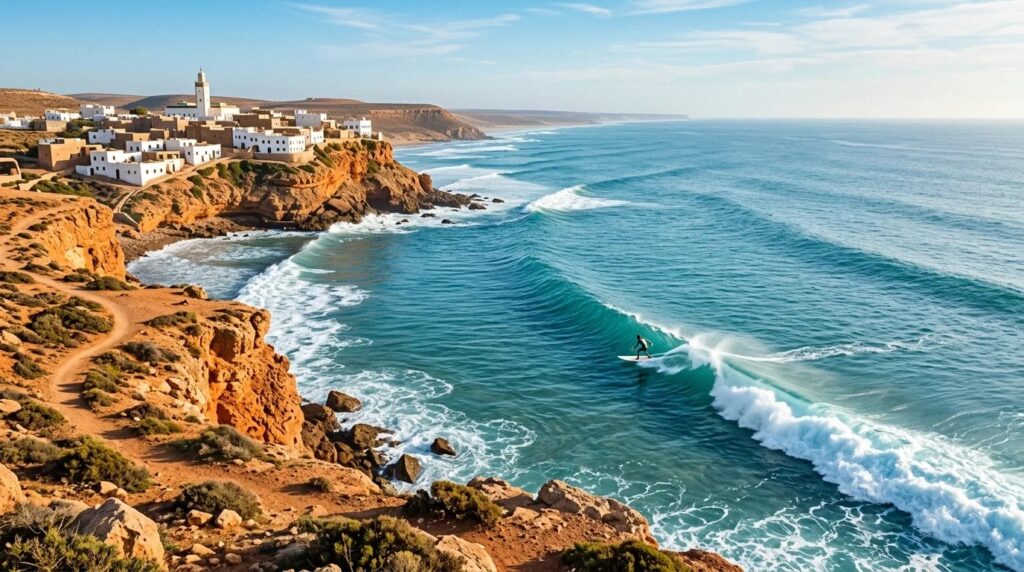
Anchor Point est le break de surf le plus célébré du Maroc, et l’un des point breaks les plus réputés au monde entier. Par bonne houle propre de NO, la vague déroule sur jusqu’à 600 mètres — trois à quatre fois la longueur d’un ride moyen de beach break — s’étirant parfaitement le long du point rocheux d’une manière qui vous donne l’impression d’être dans un film de surf, même si vous regardez simplement depuis la falaise.
Anchor Point tient la grosse taille. Deux fois la hauteur d’un homme n’est pas rare en pleine saison. La vague est puissante, le drop est raide, et les sections demandent de l’expérience et de l’engagement. C’est le paradis du right-hander — rapide, long, mécaniquement parfait le bon jour.
The crowds. Yes, they exist. During big winter swells, Anchor Point attracts experienced surfers from all over the world, and the lineup can get dense. The solution: early morning sessions before 8 a.m., when the light is beautiful anyway and the crowds haven't yet gathered. Come back in the afternoon and be prepared to share the experience.
If Taghazout is on your bucket list of surf spots to visit before you die, Anchor Point is the reason. It lives up to every word of its reputation.
Comment y Arriver : De l’Aéroport d’Agadir au Lineup
Getting to Taghazout is simpler than you think.
Depuis l’Aéroport Agadir Al Massira (AGA) :
- Grand taxi: L’option la plus authentiquement marocaine. Négociez un prix fixe avant de monter — comptez 150 à 200 MAD (environ 15 à 20 €) pour le trajet de ~45 minutes. Ça vaut le détour rien que pour l’expérience.
- Airport shuttle / transfer: Plusieurs surf camps et maisons d’hôtes proposent des transferts directs depuis l’aéroport. Si vous séjournez dans un camp, demandez-leur d’organiser ça — c’est souvent inclus ou à faible coût.
- Rental car: Idéale si vous voulez la flexibilité d’explorer le littoral d’Imsouane jusqu’à Mirleft. Les routes sont bien goudronnées, et une voiture ouvre l’accès à des spots simplement inaccessibles autrement.
Options de vol depuis l’Europe : Direct flights to Agadir operate regularly from London Gatwick, Amsterdam, Paris Orly, Madrid, and several other European hubs—often with flight times under 3 hours and 30 minutes. For American and Canadian travelers, Casablanca (CMN) with a layover is the most common route.
Ce qu’il Faut Emporter : La Liste de Matériel Honnête
Having the right equipment makes a noticeable difference here, especially in winter.
Wetsuits: Une 3/2mm wetsuit est la norme d’octobre à avril quand les températures de l’eau oscillent entre 16°C et 18°C. L’O’Neill Hyperfreak 3/2mm est un choix populaire spécifiquement pour le surf de point break — son néoprène ultra-stretch rend le paddling lors de longs lineups significativement moins épuisant. Pour les sessions de fin de printemps et d’été, une A 2mm shorty or a lycra suit will suffice.
Surfboards:
- Beginners: Foam boards are available for rent on the main street and in Tamraght — usually 250 to 350 MAD per day
- Intermediate: a mid-length fun shape is perfectly suited to Hash Point and Mysteries
- Advanced: your usual shortboard; bring your own if possible, or check at Decathlon Agadir
Sun protection: The Moroccan sun is no joke, even in winter. Waterproof zinc-based sunscreen (SPF 50+) is essential for all-day sunbathing sessions. Your skin will thank you.
Pour l’eau froide : Les bouchons d’oreilles SurfEars 3.0 valent vraiment la peine pour les sessions hivernales prolongées — l’exostose est une vraie pathologie qui s’accumule lors d’expositions répétées à l’eau froide, et la prévention est significativement plus simple que le traitement.
After the session: A dryrobe or similar garment has become almost standard in Taghazout's parking lots during the winter. The Atlantic wind after two hours of surfing is biting, and changing clothes in the open air without protection is an unpleasant experience best avoided.
Surf Camp or Independent Rental: Which One Suits You?
C’est la question logistique la plus courante que l’on me pose, et la réponse honnête est : ça dépend entièrement de ce pour quoi vous venez.
Choose a surf camp if:
- You're traveling alone and want instant social interaction.
- You are a beginner or intermediate and would like structured coaching
- You want everything to be managed in a single booking (accommodation, guiding, meals, equipment)
- L’expérience communautaire fait partie de l’attrait
Choose a self-catering rental if:
- You are travelling in a group or as a couple and want your own space
- Vous êtes un surfeur expérimenté qui connaît les spots et a juste besoin d’une base
- Vous travaillez à distance et avez besoin d’un WiFi fiable et d’un environnement calme
- You want the freedom to cook your own meals, manage your own schedule, and choose your own surfing partners.
Platforms like Kriwli.com specialize in independent surf rentals in the Taghazout and Tamraght area — a great option for digital nomads and self-guided surf travelers who want privacy without sacrificing location.
Étiquette dans l’Eau : Les Règles que Personne n’Écrit
One thing that truly distinguishes Taghazout from beginner surf destinations is that several of its main spots — Anchor Point, Killers — have established lineups with a real hierarchy and unwritten rules.
Some basics:
- Don't snake. One surfer per wave, priority given to the person closest to the peak
- Don't sneak around. Paddler autour de quelqu’un pour lui voler la priorité se remarque et se retient
- Please respect the premises. The Moroccan surfers who surf these spots daily have earned their place in the lineup. Respect it.
- Read the lineup before you paddle. Sit on the cliff for 15 minutes. Watch how the set waves break, where the priority positions are, who's who
- En cas de doute, allez à l’épaule. Catching the less-than-perfect section of a wave is better than creating a conflict at a spot you're visiting for a week.
The lineup culture at Anchor Point and Killers during peak season is serious business. Early morning sessions really solve most of the problems — the crowd is smaller, the light is magical, and you earn respect simply by being there before everyone else.
In summary
Taghazout n’est pas qu’un voyage de surf. C’est le genre d’endroit qui réorganise votre conception de ce que signifie vraiment une semaine bien vécue.
The waves are real, the culture is rich, the food is remarkable, and the golden hour light on the Atlantic does something to your brain that no productivity app can replicate. And whether you're here to finally learn to surf, to chase the longest ride of your life at Anchor Point, or somewhere in between—this coastline delivers.
Book the flight. Pack the 3/2mm. Check the forecasts obsessively on Surfline pendant les trois semaines avant votre départ.
You'll know when the swell arrives.
Planning your first trip to Taghazout? Leave your level and travel dates in the comments — I'd be happy to point you towards the best spots and the best time of year.